
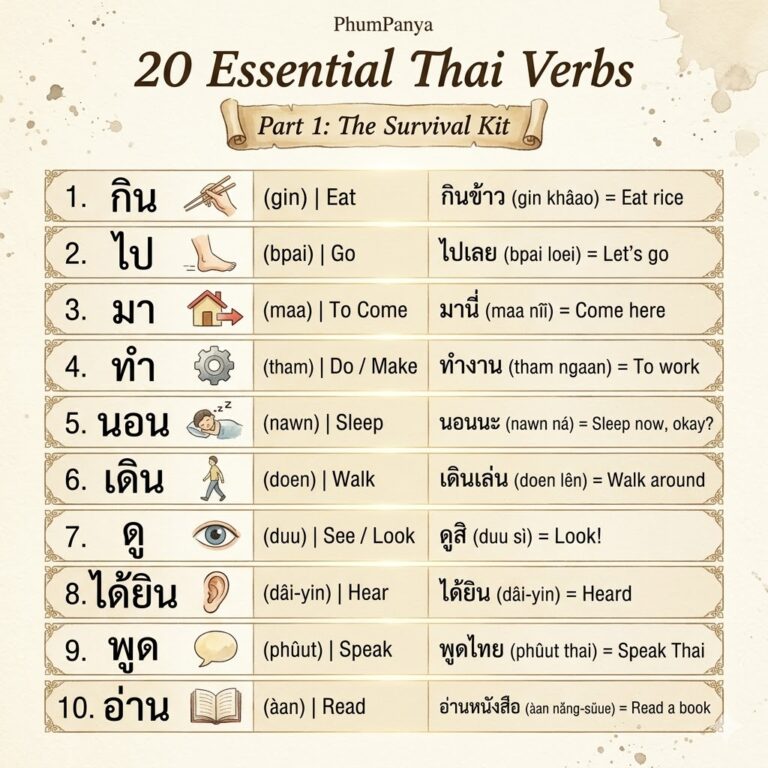
Thai Verbs: The 20 Essential Action Words
9 min readIf you want to move through Thailand—literally or socially—you need these twenty words. They’re primal, and they describe everything from eating breakfast to understanding someone’s heart.
If you’re doing it, Thai verbs on this list probably cover it.
These twenty words work because Thai verbs don’t conjugate—they combine like building blocks. Master these roots, and you can construct hundreds of expressions.
The Survival Kit
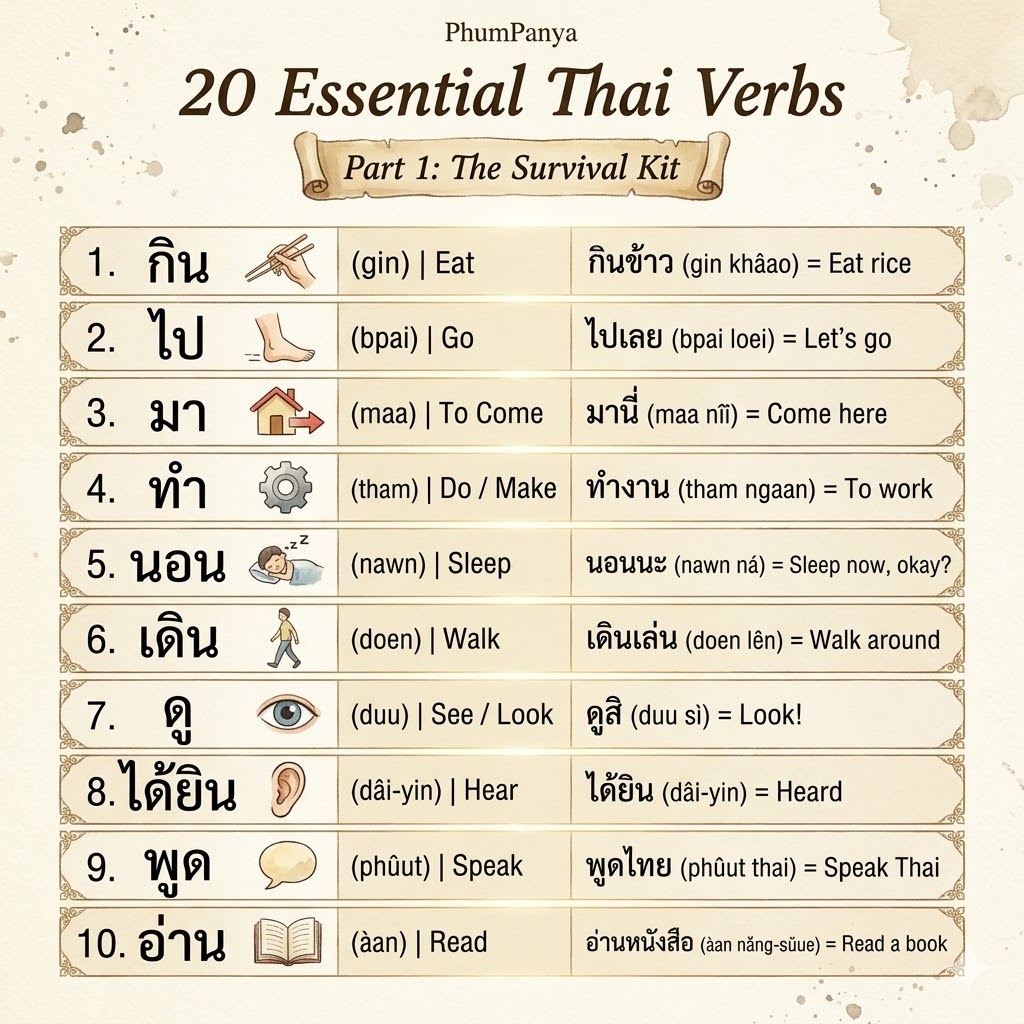
กิน (gin) | Eat
Example:
กินข้าวหรือยัง? (gin khâao rǔu yang?)
“Have you eaten yet?” (The Thai way of asking “How are you?”)
ไป (bpai) | Go
Example:
ไปไหนมา? (bpai nǎi maa?)
“Where have you been?” (Casual greeting among friends)
Common phrase:
ไปเลย (bpai loei) = “Let’s go” / “Go ahead”
มา (maa) | To Come
Example:
มาบ้านฉันสิ (maa bâan chǎn sì)
“Come to my house”
ทำ (tham) | To Do / To Make / Work
Example:
ทำอะไรอยู่? (tham à-rai yùu?)
“What are you doing?”
Common usage:
ทำงาน (tham ngaan) = “To work” (literally: “do work”)
นอน (nawn) | Sleep
Example:
อยากนอนแล้ว (yàak nawn láeo)
“I want to sleep now”
เดิน (doen) | To Walk
Example:
เดินเล่นที่ชายหาด (doen lên thîi chaai-hàat)
“Walk around at the beach”
How You Interact
ดู (duu) | To See / To Look / Show in Thai
Example:
ดูหนังกันไหม? (duu nǎng gan mǎi?)
“Want to watch a movie together?”
Common phrase:
ดูสิ (duu sì) = “Look!” / “Show me”
ได้ยิน (dâi-yin) | To Hear
Example:
ได้ยินไหม? (dâi-yin mǎi?)
“Can you hear [me]?”
พูด (phûut) | To Speak
Example:
พูดไทยเป็นไหม? (phûut thai bpen mǎi?)
“Can you speak Thai?”
อ่าน (àan) | To Read
Example:
อ่านหนังสือ (àan nǎng-sǔue)
“Read a book”
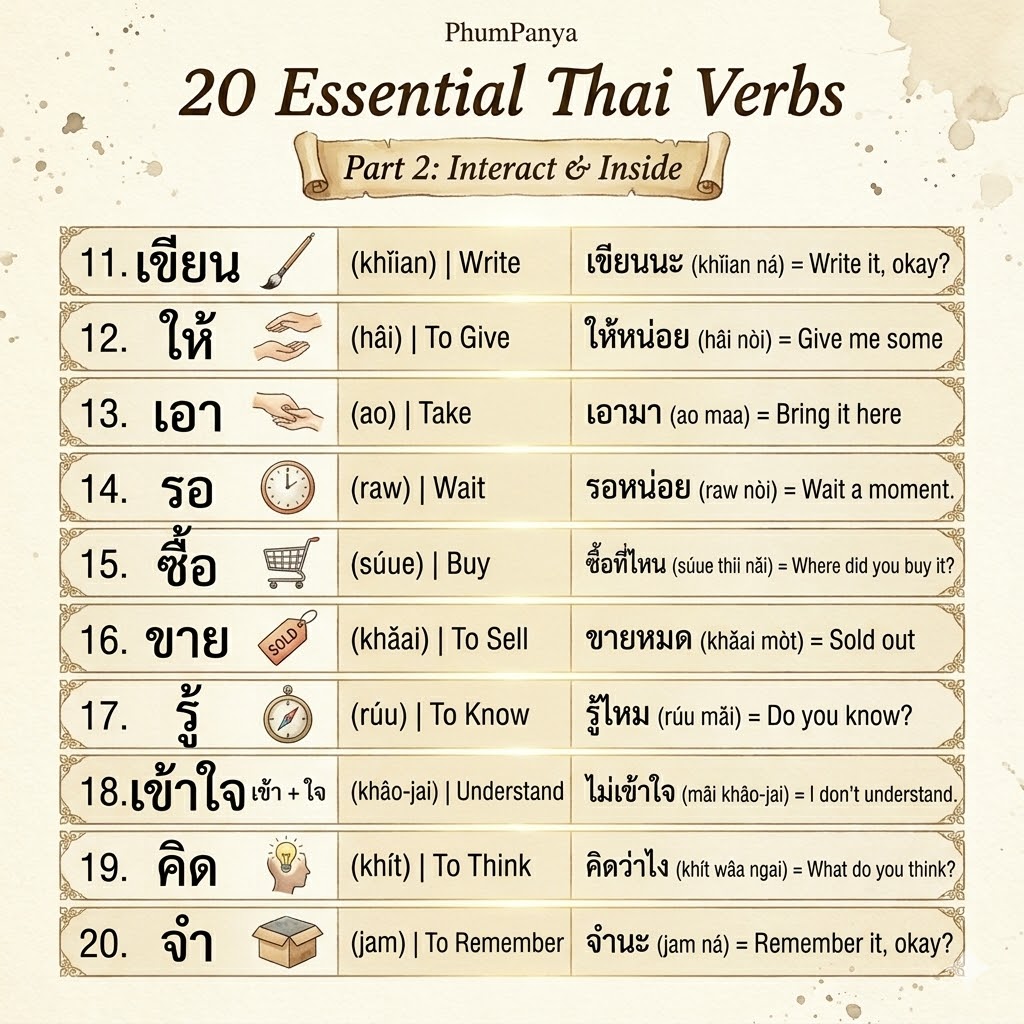
เขียน (khǐian) | To Write
Example:
เขียนชื่อที่นี่ (khǐian chûue thîi nîi)
“Write your name here”
ให้ (hâi) | To Give
Example:
ให้ฉันหน่อย (hâi chǎn nòi)
“Give me some”
เอา (ao) | Take
Example:
เอาไปเลย (ao bpai loei)
“Just take it”
Common usage:
เอามา (ao maa) = “Bring it here”
เอาไป (ao bpai) = “Take it away”
รอ (raw) | Wait
Example:
รอหน่อย (raw nòi)
“Wait a moment”
Common phrase:
รอมานานแล้ว (raw maa naan láeo) = “I’ve been waiting a long time”
ซื้อ (súue) | Buy
Example:
ซื้อที่ไหน? (súue thîi nǎi?)
“Where did you buy it?”
ขาย (khǎai) | To Sell
Example:
ขายหมดแล้ว (khǎai mòt láeo)
“Sold out”
The “Inside” Actions
รู้ (rúu) | To Know
Example:
ไม่รู้ (mâi rúu)
“I don’t know”
เข้าใจ (khâo-jai) | Understand
Literal meaning: “Enter the heart”
Structure:
- เข้า (khâo) = Enter
- ใจ (jai) = Heart
Understanding someone isn’t a logical calculation—it’s an emotional arrival.
Example:
ฉันเข้าใจเธอ (chǎn khâo-jai thoe)
“I understand you”
Common phrase:
ไม่เข้าใจ (mâi khâo-jai) = “I don’t understand”
คิด (khít) | To Think
Example:
คิดว่าอย่างไร? (khít wâa yàang-rai?)
“What do you think?”
จำ (jam) | To Remember
Example:
จำได้ไหม? (jam dâi mǎi?)
“Do you remember?”
How to Use This List
Don’t try to memorize all twenty Thai verbs at once. Pick one and listen for it during a single hour of Thai conversation.
You’ll be surprised—กิน (eat) and ไป (go) are basically the background noise of Thailand. Once you start hearing them, you’ll realize these twenty verbs carry about 80% of daily Thai life.
Explore Thai Words
Want to see the visual logic behind each verb? Click any word above to see its full Library Card, complete with etymology and cultural context:
Related posts
 ตั้งแต่…จนถึง: The Bracket That Holds Thai Time and Space
ตั้งแต่ and จนถึง are the two anchors that bracket time, space, and everything in between.
3 min read เปิด & ปิด: The Two Switches That Run Thai Life
English needs dozens of verbs — turn on, switch off, launch, activate, shut down. Thai needs two. เปิด opens everything. ปิด closes it. Here’s the logic behind the most useful word pair in the language.
2 min read Telling Time in Thai: How Drums, Gongs and Watchmen Built the Clock
The Thai clock resets four times a day. Instead of counting straight to 24, each period starts from one again — and each is named after the instrument that ancient watchmen used to signal it.
10 min read