

ตั้งแต่…จนถึง: The Bracket That Holds Thai Time and Space
2 min readตั้งแต่ (dtâng-dtàe) — From / Since. The starting post.
จนถึง (jon-thǔeng) — Until / To. The destination.
The Root
ตั้งแต่ comes from ตั้ง — to set, to establish, to plant something firmly in the ground. When you say ตั้งแต่, you are driving a stake into a point in time or space and saying: here is where this begins.
จนถึง combines two words. จน means until or up to the limit. ถึง means to reach, to arrive. Together they describe the moment you stop — not because you gave up, but because you got there.
Three Ways to Use It
Time
- ตั้งแต่เช้าจนถึงเย็น — From morning until the cool of the day.
- ทำงานตั้งแต่แปดโมง — Working since 8 o’clock.
Space
- ตั้งแต่หัวจนถึงเท้า — From head to toe.
- เดินตั้งแต่บ้านจนถึงโรงเรียน — Walking from home until reaching school.
People & Range
- กินได้ตั้งแต่เด็กจนถึงผู้ใหญ่ — Can be eaten by everyone from children to adults.
ถึง Alone: The Destination Without the Journey
จนถึง contains ถึง — but ถึง stands on its own too, and it works differently.
On its own, ถึง simply marks arrival or a boundary. No sense of distance traveled, no implication of effort. Just: you are there.
- จาก กรุงเทพฯ ถึง เชียงใหม่ — From Bangkok to Chiang Mai. Point A to point B.
- ทำงาน ถึง ห้าโมงเย็น — Working until 5 PM. The boundary, stated plainly.
Add จน in front and the meaning shifts. จนถึง implies you kept going until you got there — there was a distance, a duration, a span of something that had to be crossed. The journey is inside the word.
Use ถึง when you’re marking a point. Use จนถึง when you’re describing everything between here and that point.
Related posts
 เสียงวรรณยุกต์ – Thai Tone Etymology
The Thai word for tone breaks into three roots — เสียง (sound), วรรณ (letter, from Sanskrit varṇa), and ยุกต์ (joined, from Sanskrit yukta). Native Tai and Sanskrit fused into one concept.
1 min read Down the Rabbit Hole of ฐ: One Thai Letter’s Journey Across Eurasia
I do love digging through the seams of Thai vocabulary. You sit down, say, to read about the letter — tɔ̌ɔ tǎan, the 16th consonant of the Thai alphabet. And several hours later you find yourself far from Thailand, gleefully time-traveling back and forth across Eurasia. Welcome down the rabbit hole.
3 min read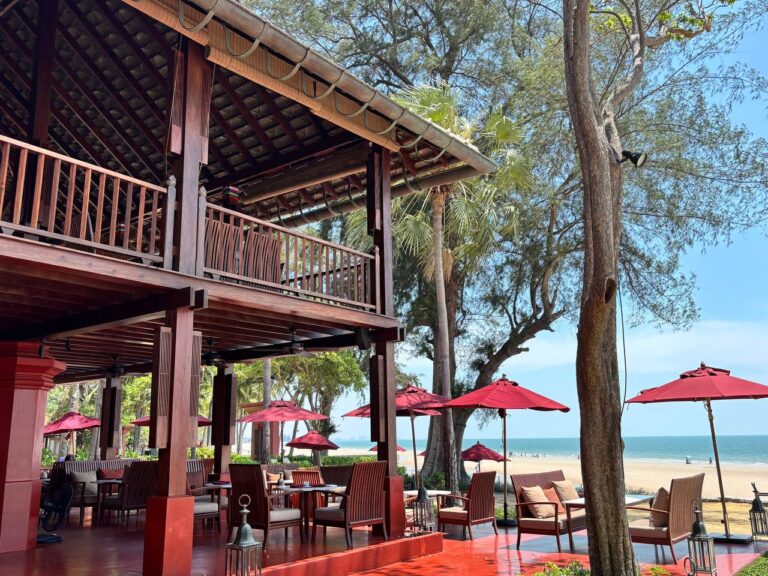 McFarland House Hua Hin: A Wooden House Between Two Worlds
Among the beachfront hotels of Hua Hin stands a wooden house from another century. It once belonged to an American who became Siamese aristocracy, and who left behind a dictionary that still teaches Thai today.
6 min read