
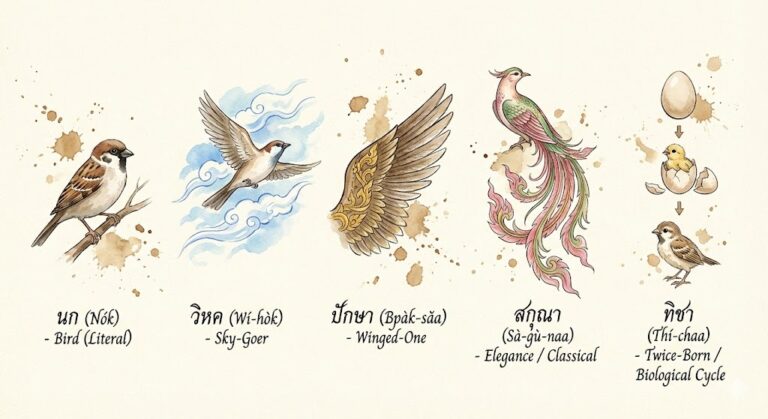
Bird in Thai Language: From นก to ทิชา — The Five Levels of “Bird”
3 min readIn Thai, there are five words, each revealing a different way of seeing the same creature – bird – from the physical animal to a philosophical concept.
Understanding bird in Thai languagу is about seeing how Thai creates hierarchy through language: everyday life uses native Thai (นก), while poetry, mythology, and philosophy borrow from Sanskrit and Pali.
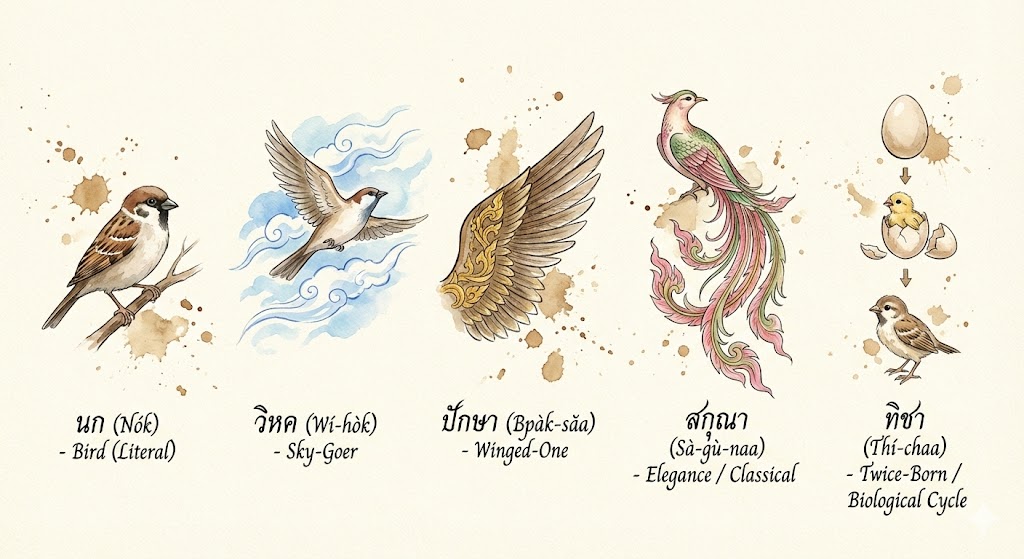
The Visual: Bird Vocabulary Hierarchy
The Insight: Why Five Words for One Bird?
Thai doesn’t just translate concepts — it ranks them by register. The word you choose reveals:
- Context (casual conversation vs formal literature)
- Education level (native Thai vs Sanskrit knowledge)
- Philosophical depth (physical creature vs metaphysical concept)
Let’s decode each level:
นก (nók) — The Literal Atom
Type: Native Thai
Meaning: Bird (the animal itself)
Usage: Everyday conversation, pets, biology
Example:
- นกบิน (nók bin) = A bird flies
- นกแก้ว (nók gâeo) = Parrot
This is the word you’ll use 99% of the time. Simple, direct, native Thai.
วิหค (wí-hòk) — The “Sky-Goer”
Etymology: Sanskrit vi (sky/space) + ga (to go)
Literal meaning: One who moves through the air
Usage: Poetry, literature, formal names for aviation
Cultural insight: Thai borrows this when describing birds poetically — emphasizing their ability to traverse the sky, not just their physical form.
Example:
- วิหคเหาะเหิน (wí-hòk hò-hěen) = Birds soaring gracefully (literary)
ปักษี (bpàk-sǐi) — The “Winged-One”
Etymology: Sanskrit pakṣa (wing)
Literal meaning: Winged being
Usage: Mythology, formal biology, Garuda (divine bird)
Why it matters: This word focuses on anatomy (the wing) rather than the creature. Used when talking about mythological birds like the Garuda (ครุฑ / พญาครุฑ).
Variant: ปักษา (bpàk-sǎa) refers to the entire class of birds.
สกุณา (sà-gù-naa) — The “Classical Bird”
Etymology: Pali/Sanskrit sakuṇa
Meaning: Bird (general, soft register)
Usage: Classical Thai dance, ancient literature, elegant/feminine contexts
Gender note: สกุณี (sà-gù-nii) = female bird (used in classical poetry)
Example:
- Classical Thai dance featuring bird characters uses this term for grace and formality.
ทิชา (thí-chaa) — The “Twice-Born”
Etymology: Sanskrit dvi (two) + ja (born)
Literal meaning: Twice-born
Cultural logic: A bird is born twice — once as an egg, once as a hatchling
Usage: Academic, philosophical, also used metaphorically for Brahmins (spiritually “born again”)
This is the most philosophical register — rarely used in conversation, reserved for deep cultural or religious contexts.
Related posts
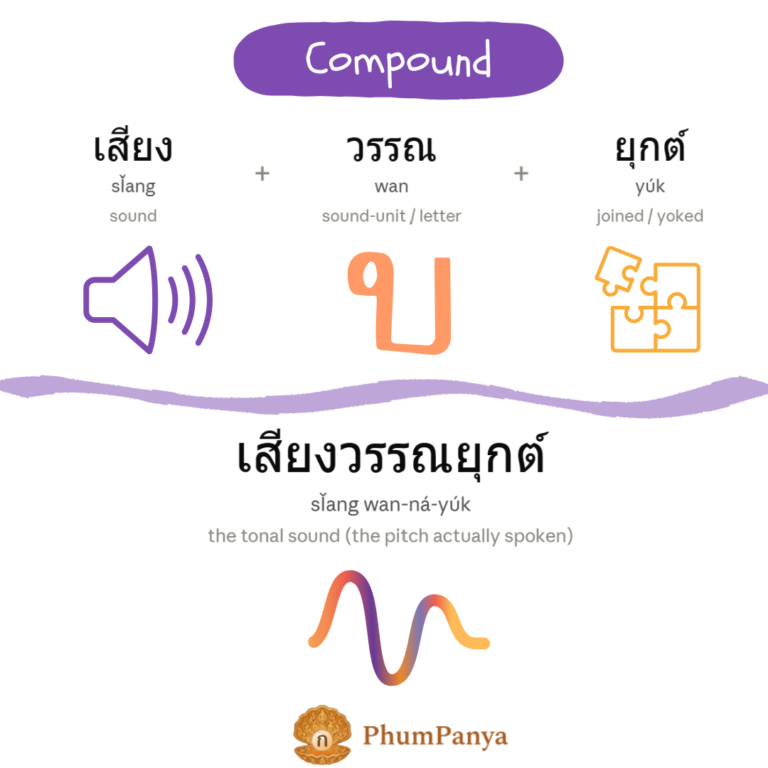 เสียงวรรณยุกต์ – Thai Tone Etymology
The Thai word for tone breaks into three roots — เสียง (sound), วรรณ (letter, from Sanskrit varṇa), and ยุกต์ (joined, from Sanskrit yukta). Native Tai and Sanskrit fused into one concept.
1 min read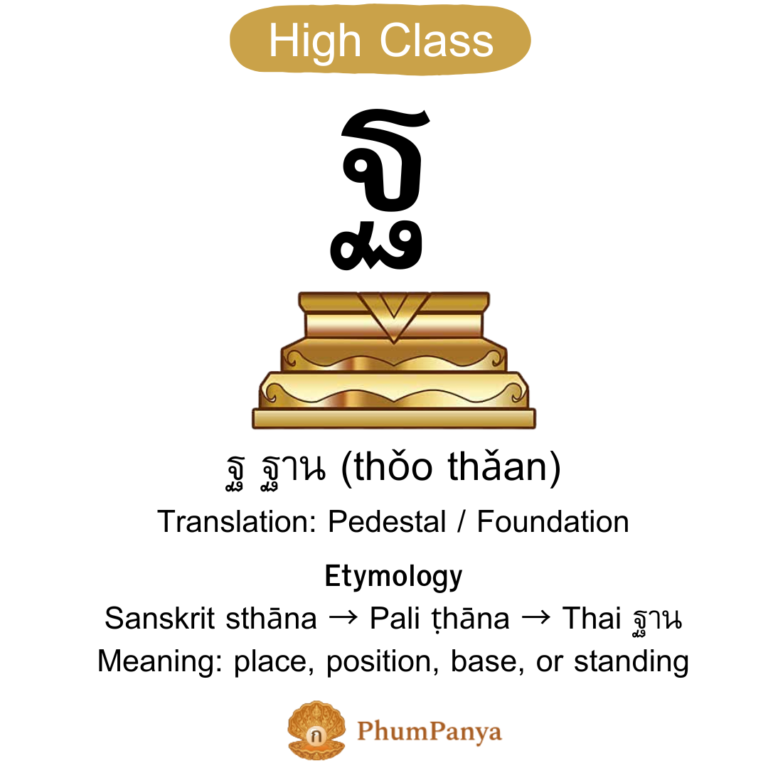 Down the Rabbit Hole of ฐ: One Thai Letter’s Journey Across Eurasia
I do love digging through the seams of Thai vocabulary. You sit down, say, to read about the letter — tɔ̌ɔ tǎan, the 16th consonant of the Thai alphabet. And several hours later you find yourself far from Thailand, gleefully time-traveling back and forth across Eurasia. Welcome down the rabbit hole.
3 min read McFarland House Hua Hin: A Wooden House Between Two Worlds
Among the beachfront hotels of Hua Hin stands a wooden house from another century. It once belonged to an American who became Siamese aristocracy, and who left behind a dictionary that still teaches Thai today.
6 min read