
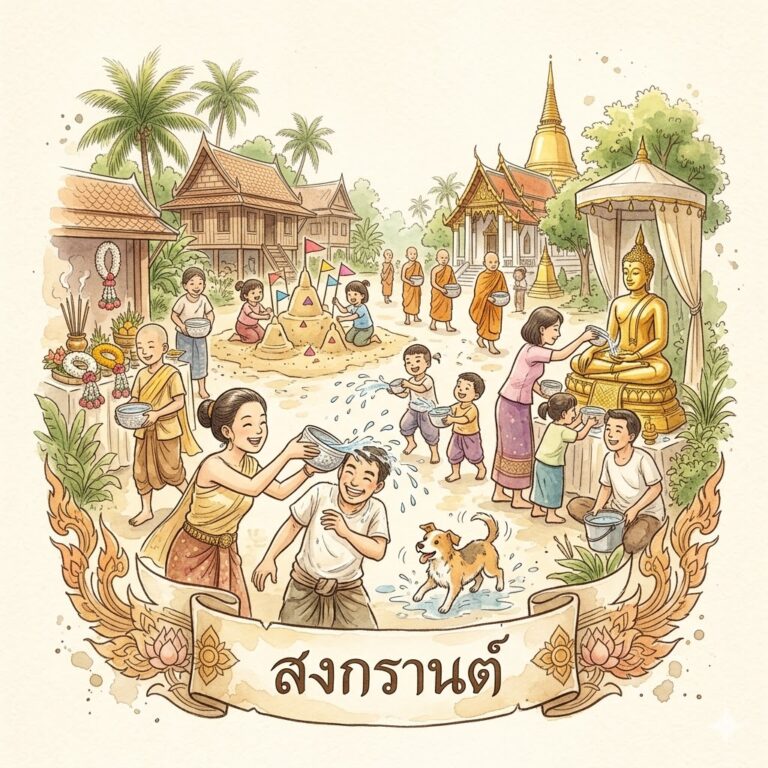
Songkran Festival: Thailand’s Water Celebration & Thai New Year
7 min readSongkran festival is Thailand’s most important holiday—a three-day celebration that marks Thai New Year with water, merit-making, and family reunions. Every April 13-15, Thailand transforms into a nationwide water festival where strangers drench each other in the streets, elders receive blessings, and temples overflow with offerings.
This isn’t just a party. Songkran is renewal—washing away last year’s bad luck, honoring ancestors, and starting fresh. The water you see thrown everywhere? It started as gentle blessings poured over elders’ hands. Now it’s bucket fights on Silom Road.
Understanding Songkran means understanding how Thais think about time, family, and purification.
The Meaning of สงกรานต์ (Songkran)
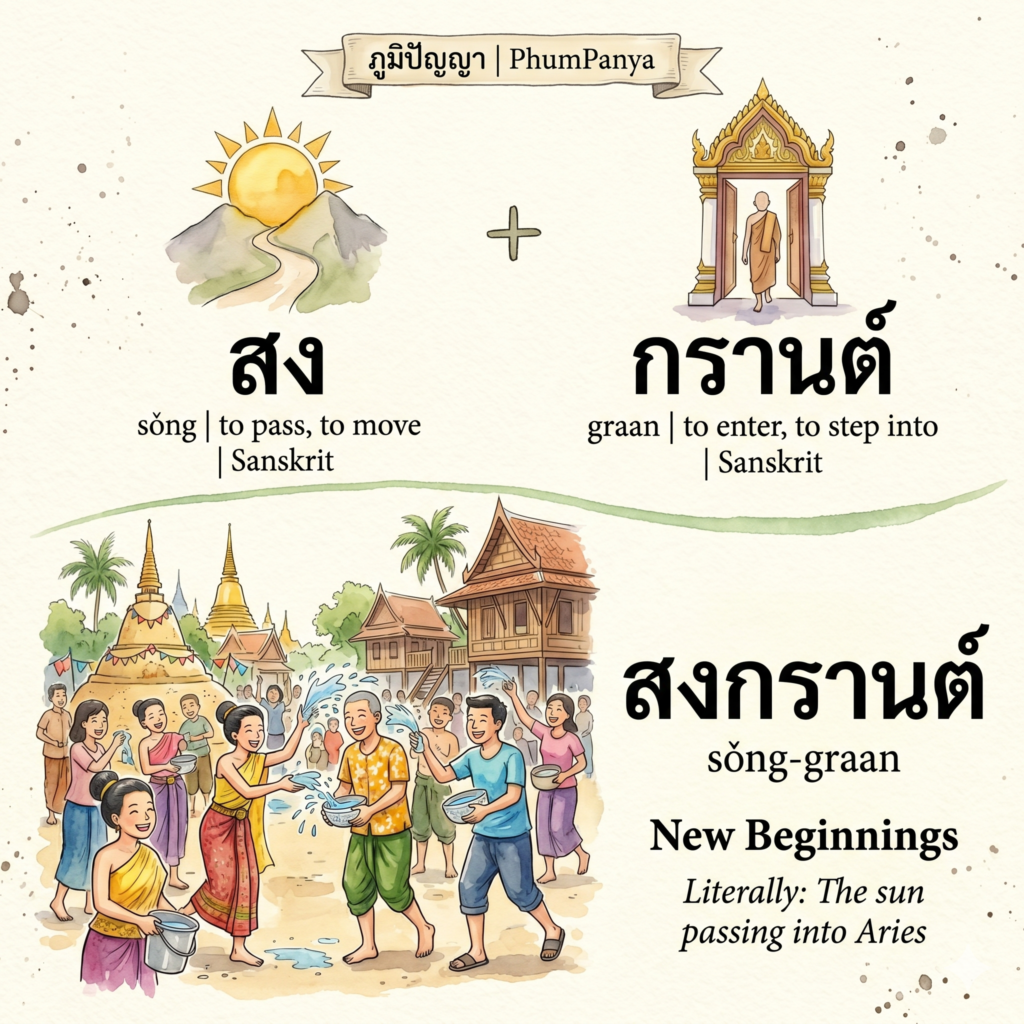
สงกรานต์ (sǒng-graan) comes from Sanskrit Saṅkrānti (สังกรานต์), meaning “astrological passage” or “transformation.”
Structure:
- สง (sǒng) = to pass, to move
- กรานต์ (graan) = to enter, to step into
Literal meaning: “The sun passing into Aries”—the moment the sun shifts into a new zodiac sign, marking the traditional Thai New Year based on solar movement.
Cultural meaning: New beginnings. The word itself captures transition—you’re not just celebrating a date change, you’re marking a cosmic shift. Old year leaves, new year enters.
This is why Songkran rituals focus on cleansing. You wash Buddha images, pour water on elders’ hands, clean your house, and yes—throw water on everyone you meet. The logic: purify everything before the new cycle begins.
Why Water?
Songkran water isn’t just fun—it’s purification. Water washes away bad luck, cleanses the spirit, and marks a fresh start.
The sacred version:
รดน้ำดำหัว (rót nám dam hǔa) = “Pour water on elders’ hands.” You gently pour scented water over your parents’ and grandparents’ hands as a sign of respect. They give you blessings in return.
This is Songkran’s heart: quiet reverence, family bonds, spiritual cleansing. The water is perfumed with jasmine or roses. The moment is intimate. The exchange—water for blessings—connects generations.
The commercialized version:
Plastic water guns. Hoses. Ice water. Drunk tourists on Silom Road. Loudspeakers blasting EDM. What was once sacred has become a product.
The modern Songkran—especially in Bangkok’s tourist zones—turns a spiritual holiday into a wet t-shirt contest. The plastic waste alone is staggering: thousands of water guns end up in landfills every year.
The traditional way still exists, but you have to look for it:
- Chiang Mai’s temples still hold proper ceremonies
- Village Songkran in Isaan focuses on family and merit-making
- Private homes across Thailand preserve รดน้ำดำหัว rituals
Essential Songkran Vocabulary
วันสงกรานต์ (wan sǒng-graan) | Songkran Day
Literally: “Songkran day.” Used to refer to the holiday period.
Example:
วันสงกรานต์ปีนี้ไปไหน? (wan sǒng-graan bpee-níi bpai nǎi?)
“Where are you going for Songkran this year?”
ทำบุญ (tham bun) | Make merit
Structure:
- ทำ (tham) = to do
- บุญ (bun) = merit, good karma
Example:
ไปทำบุญที่วัด (bpai tham bun thîi wát)
“Go make merit at the temple”
รดน้ำดำหัว (rót nám dam hǔa) | Pour water on elders’ heads
Structure:
- รด (rót) = to pour, to sprinkle
- น้ำ (nám) = water
- ดำหัว (dam hǔa) = black head (respectful term for elders)
The core Songkran ritual—blessing elders with water.
สาดน้ำ (sàat nám) | Splash water
Structure:
- สาด (sàat) = to splash, to throw
- น้ำ (nám) = water
เจดีย์ทราย (jay-dee saai) | Sand pagoda
Structure:
- เจดีย์ (jay-dee) = pagoda, stupa
- ทราย (saai) = sand
Temple tradition: people bring sand to build small pagodas at temples, symbolically returning dirt tracked out during the year.
The Three Days & Traditions
Day 1 (April 13) วันมหาสงกรานต์ (wan má-hǎa sǒng-graan)
“Great Songkran Day”
This is preparation day:
- Clean the house (sweep out old energy)
- Prepare offerings for temple visits
- Cook special foods for family gatherings
- Set up altars with flowers and incense
Some people start water throwing, but traditionally this day is about getting ready.
Day 2 (April 14) วันเนา (wan nao)
“Middle Day” / “Idle Day”
The transition period. Officially, nothing is required—it’s the gap between old year and new year. In practice:
- Family gatherings intensify
- Temple visits begin
- Water throwing accelerates
This is the day foreigners get ambushed if they didn’t know Songkran was happening.
Day 3 (April 15) วันเถลิงศก (wan thà-lǒeng sòk)
“New Year Day”
The actual new year arrives:
- Morning temple visits (ทำบุญ at วัด)
- รดน้ำดำหัว (pouring water on elders for blessings)
- Sand pagodas built at temples
- Official celebrations begin
The blessing ritual works like this:
Younger person:
ขอพรปีใหม่ (khǒr phorn bpee-mài)
“May I ask for new year blessings?”
Elder (while receiving water):
ขอให้มีความสุข สุขภาพแข็งแรง (khǒr hâi mii khwaam-sùk, sùk-khà-phâap khǎeng-raeng)
“May you have happiness and strong health”
This exchange—water for blessings—is the heart of Songkran.
Core Traditions Across All Three Days:
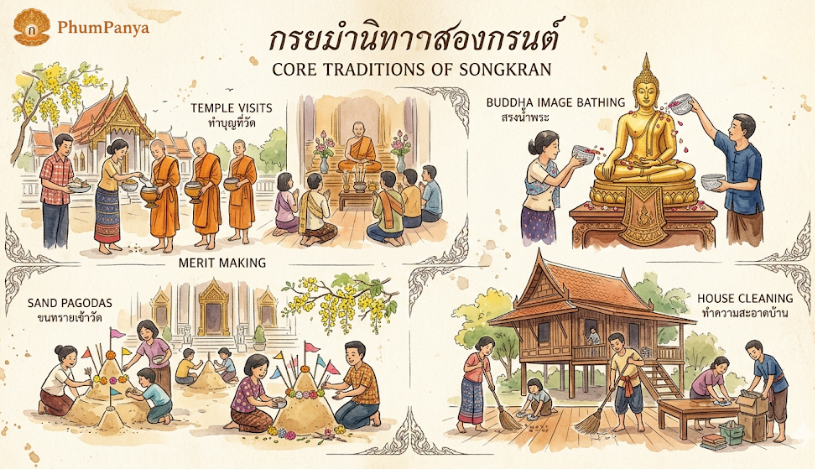
Temple visits (ทำบุญที่วัด):
People bring food offerings to monks, listen to dharma talks, and make merit for deceased relatives.
Buddha image bathing:
Gently pouring water over Buddha statues to cleanse them, symbolically purifying your own mind.
Sand pagodas (เจดีย์ทราย):
Building small stupas from sand represents returning what you’ve taken from the temple grounds throughout the year.
House cleaning:
Not just tidying—full purification. Sweeping, washing, throwing out old items. Starting the new year with a clean slate.
Related posts
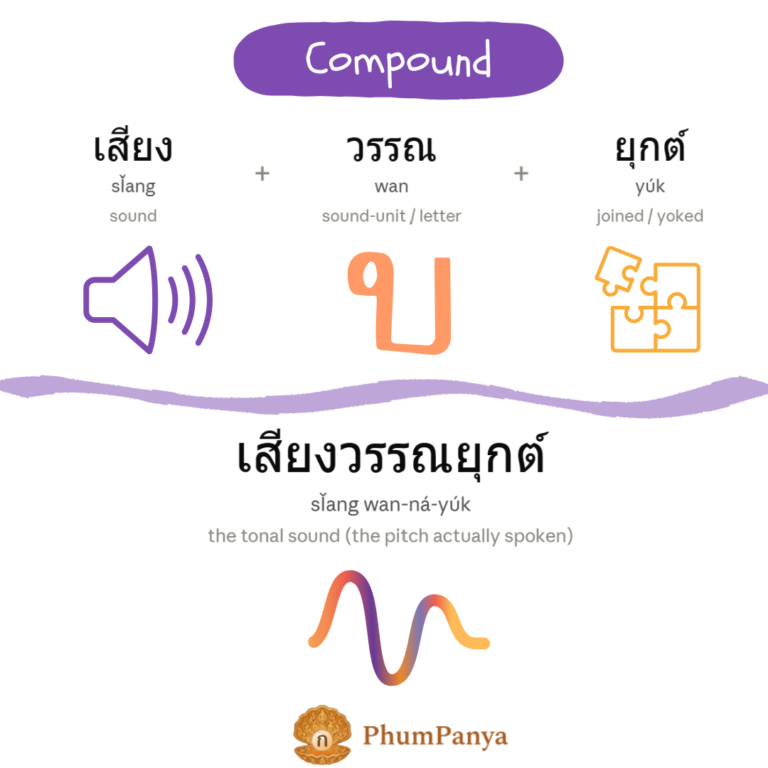 เสียงวรรณยุกต์ – Thai Tone Etymology
The Thai word for tone breaks into three roots — เสียง (sound), วรรณ (letter, from Sanskrit varṇa), and ยุกต์ (joined, from Sanskrit yukta). Native Tai and Sanskrit fused into one concept.
1 min read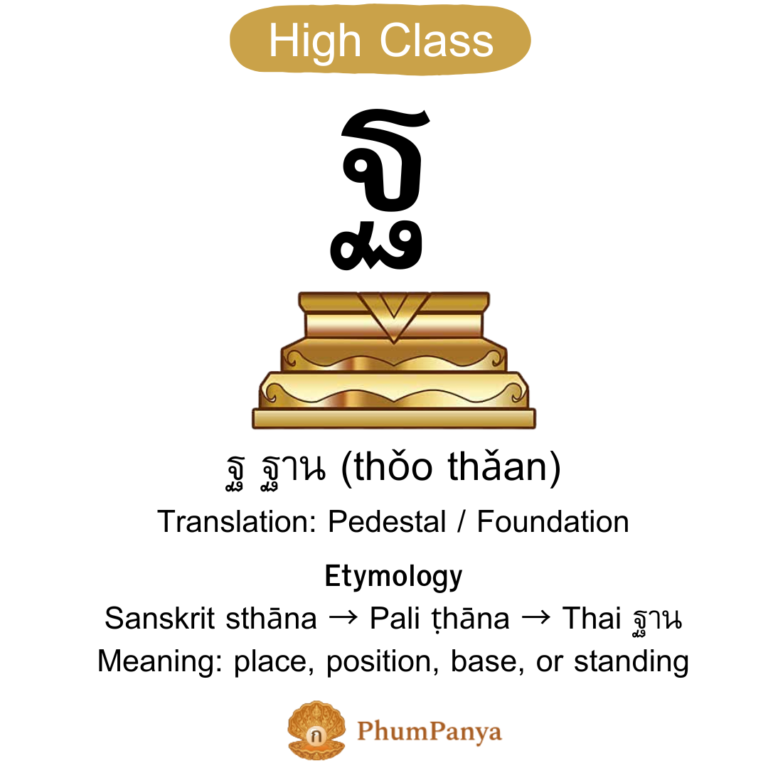 Down the Rabbit Hole of ฐ: One Thai Letter’s Journey Across Eurasia
I do love digging through the seams of Thai vocabulary. You sit down, say, to read about the letter — tɔ̌ɔ tǎan, the 16th consonant of the Thai alphabet. And several hours later you find yourself far from Thailand, gleefully time-traveling back and forth across Eurasia. Welcome down the rabbit hole.
3 min read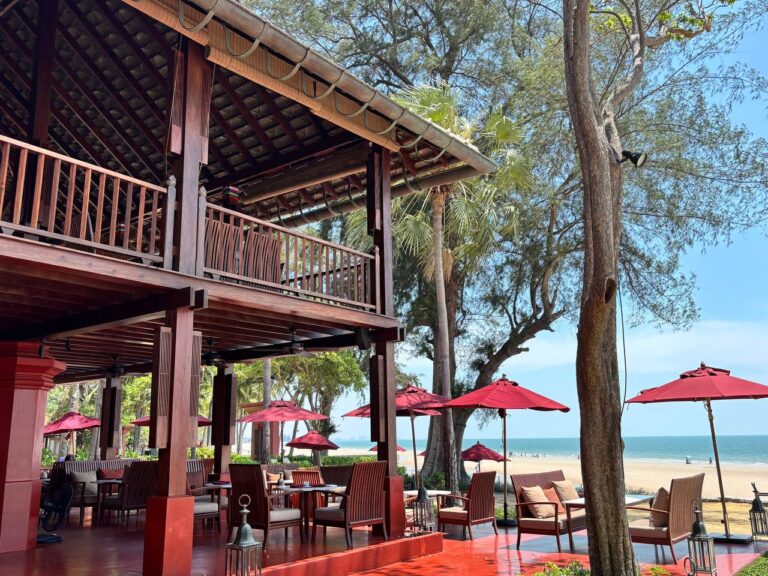 McFarland House Hua Hin: A Wooden House Between Two Worlds
Among the beachfront hotels of Hua Hin stands a wooden house from another century. It once belonged to an American who became Siamese aristocracy, and who left behind a dictionary that still teaches Thai today.
6 min read