
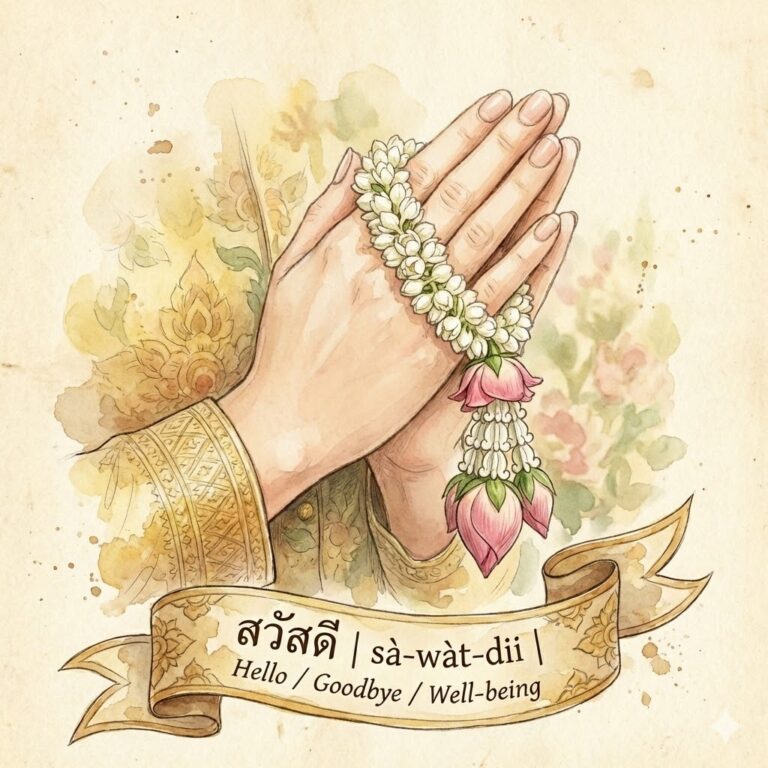
Hello in Thai: The Origin & Cultural Meaning of Sawasdee
7 min readWhen you learn hello in Thai language, you’re not learning an ancient greeting – you’re speaking a 1943 government invention that transformed how an entire nation says “hi.”
Most language learners assume สวัสดี (sawasdee) has been used for centuries. It hasn’t. It was officially mandated on January 22, 1943 by Field Marshal Plaek Phibunsongkhram as part of his “Cultural Mandates” (Ratthaniyom) – a radical nation-building campaign during World War II.
Understanding hello in Thai means seeing how Thailand engineered social hierarchy, gender markers, and Sanskrit philosophy into a single standardized greeting. Learning to say hello in Thai language reveals nation-building through linguistics.
The Anatomy of Sawasdee
สวัสดี (sà-wàt-dee)
Sanskrit DNA:
- สุ (su) = Good / Well / Beautiful
- อสฺติ (asti) = To be / To exist / To happen
- Combined: Svasti (สวัสติ) → Sawasdee (สวัสดี)
Literal meaning: “May well-being exist” or “May auspiciousness be upon you”
The Insight: How Thailand Invented “Hello”
The Architect: Phraya Upakit Silapasan
Born: Nim Kanchanachiwa
Role: Professor at Chulalongkorn University’s Faculty of Arts
The experiment began in 1933: He started using “sawasdee” among students and colleagues, wanting a greeting that felt “civilized” and distinctly Thai while drawing from Sanskrit svasti (well-being).
The mandate came in 1943: Ten years later, the government issued an official decree making sawasdee the national standard greeting.
The Context: Nation-Building Through Language
This wasn’t just about saying hello in Thai. It was part of Phibunsongkhram’s larger campaign to modernize Thailand during WWII, which included:
- Changing the country’s name from Siam to Thailand
- Mandating Western-style clothing (hats and gloves)
- Standardizing cultural behaviors to project national unity
The cultural resistance: Many elders in the 1940s felt sawasdee sounded “theatrical”—like something from a likay (traditional Thai theater). It took the force of law and constant radio promotion to turn this “artificial” word into a natural habit.
Before Sawasdee: How Thais Greeted Each Other
Before 1943, Thai culture relied on relational logic rather than formal greetings. The wai (physical gesture) was primary; speech was secondary and flexible.
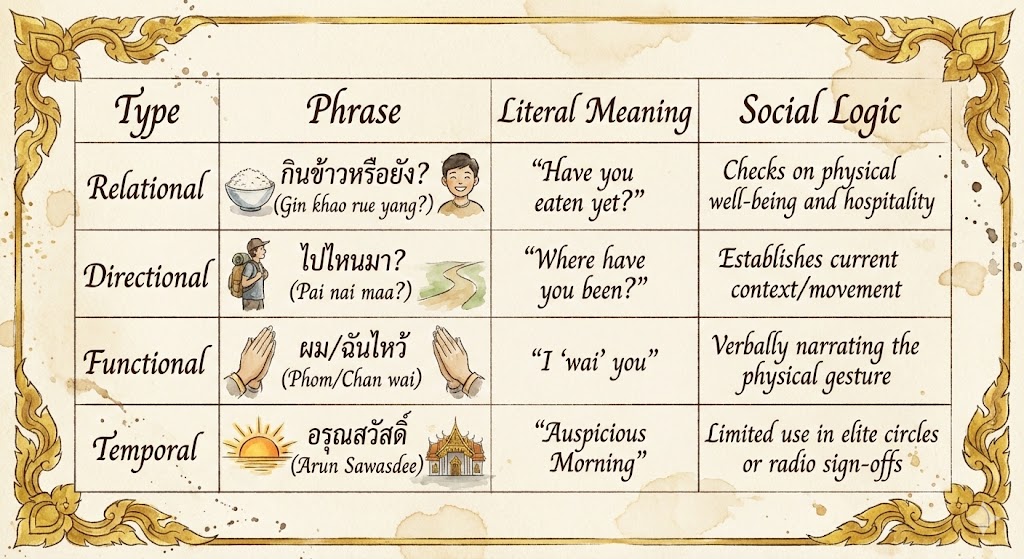
There was no universal verbal greeting that worked across all social classes.
The Three Layers of Sawasdee Today
Layer 1: The Sanskrit Blessing
When you say sawasdee, you’re not saying “hi”—you’re invoking a state of grace:
- สุ (su) = Good / Beautiful
- อสฺติ (asti) = To exist / To be
Combined meaning: “May goodness exist for you” or “May you dwell in well-being”
This is why sawasdee appears in:
- สวัสดีปีใหม่ (Sawasdee Pee Mai) = Happy New Year (Literally: “May the new year bring well-being”)
- ราตรีสวัสดิ์ (Ratri Sawasdee) = Good night
Layer 2: Hello in Thai Language Male vs Female
You never say just “sawasdee.” You must add a gender-based politeness particle.
Hello in Thai language male:
สวัสดีครับ (sà-wàt-dee khráp)
Particle: ครับ (khráp) = Masculine politeness marker
Hello in Thai language female:
สวัสดีค่ะ (sà-wàt-dee khâ)
Particle: ค่ะ (khâ) = Feminine politeness marker
Why this matters:
Thai embeds your gender identity into every polite sentence. You cannot be polite in Thai without declaring whether you’re male or female through your choice of particle.
Layer 3: The Wai Gesture
The wai predates sawasdee by centuries. It comes from Hindu-Buddhist tradition and remains the physical core of Thai greetings.
How to wai:
- Hands pressed together at chest
- Slight bow of the head
- Height indicates respect level:
- Chin level = Peers, friends
- Nose level = Elders, teachers
- Forehead level = Monks, royalty, Buddha images
Cultural logic:
You’re not just greeting a person—you’re honoring the Buddha-nature inside them.
The Shift: From Action to Incantation
Before 1943, Thai greetings were context-driven actions:
- Asking about food (showing care)
- Asking about direction (establishing context)
- Performing the wai (showing respect)
After 1943, greetings became standardized incantations:
- A fixed Sanskrit formula
- Mandatory gender markers
- National uniformity
When NOT to Say Sawasdee
Despite sawasdee being the official way to say hello in Thai language, many Thais skip it in casual contexts:
Common alternatives:
- ไปไหน? (bpai nǎi?) = “Where are you going?” (casual among friends)
- กินข้าวหรือยัง? (gin khâao rǔu yang?) = “Have you eaten yet?” (showing care)
- หวัดดี (wàt-dee) = Shortened, ultra-casual version
When to use sawasdee:
- First meetings
- Formal situations
- With strangers, elders, or authority figures
- In business contexts
The Bonus: Sawasdee’s Controversial Twin
สวัสดี (sawasdee) has a linguistic twin that reveals how the same Sanskrit root can travel in two directions—one becoming a blessing, the other a symbol of trauma.
The Shared Sacred Root: Svasti
The word Swastika (สวัสติกะ) is built from the exact same Sanskrit blocks as Sawasdee:
- สุ (su) = Good / Well
- อสฺติ (asti) = To be / Exist
- -กะ (-ka) = A diminutive suffix meaning “that which is”
Literal meaning: “That which brings well-being”
For over 5,000 years, the swastika symbol remained an “atom of good fortune” across Asia—from Bangkok temples to Kyoto shrines—representing the sun, revolving seasons, and eternal auspiciousness.
The Great Divergence
In Thailand, you see the swastika on temple gates and amulets—it feels like a visual “sawasdee,” a quiet benevolent presence. In Europe, the same geometric shape became criminalized.
What happened?
In the 1930s-40s, the Nazi Party hijacked the symbol, rotated it 45 degrees, and stripped away the “su-asti” (well-being) logic, replacing it with racial ideology. The horrors of WWII were so profound that they effectively “overwrote” 5,000 years of Sanskrit history in the Western consciousness.
This is how context becomes the architect of meaning. The raw material (the Sanskrit root) is pure and positive, but the social structure it’s placed within determines whether it functions as a blessing or a weapon.
Explore the Map
Related posts
 Thai Prepositions
Learn the prepositions that pin locations, glue ideas, mark journeys, and bridge time.
2 min read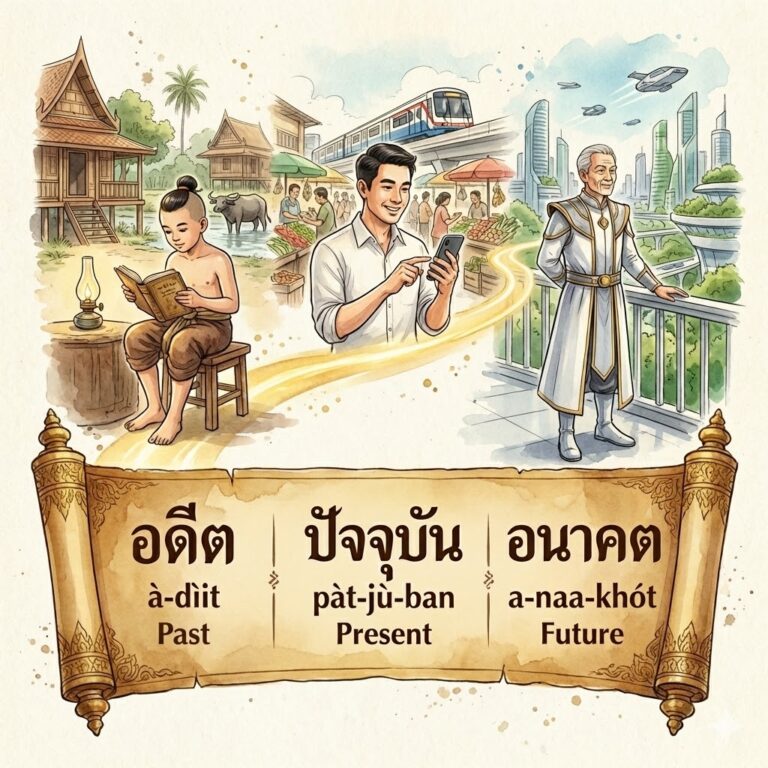 Past, Present & Future in Thai
Thai maps time through Sanskrit roots. Past is “already gone,” present is “born before you,” future is “not yet arrived.”
1 min read Come in Thai: มา vs ไป—How Direction Works
Thai has two directional words that control everything: มา pulls toward you, ไป pushes away. Learn how they work in space, time, and conversation.
1 min read